Today was a good day. I played Elliott Carter's "Figment" for Matt Haimovitz, who is pretty much my favorite living cellist. He has become famous for playing solo cello gigs at non-traditional venues such as night clubs, rock clubs, and other random places. I heard an album he recorded in 1992 featuring works by Britten, Ligeti, Hindemith, and an assortment of other 20th-century composers and it pretty much changed my whole view of cello (in a good way). Anyway, he gave a masterclass at Longy today and I was fortunate enough to play for him! It was kind of sucky to sit for 1.5 hours while other people played and then BAM, dive into "Figment," but it got easier as it went along.
I also had slept 3.5 hours last night thinking about the master class. I wasn't really nervous...it was just that my stupid brain would not shut the hell up. I had a rehearsal for Shostakovich Piano Trio at 1pm (which got delayed due to not being able to find a fucking open room), and then I realized that I was more tired than I had been in a long while, so I went home. I crashed at about 4PM, fully dressed, and woke up at 6:30PM in a little puddle of my own drool. It was quite fabulous. This is an unusual occurrence, this whole nap thing, as I take about 3-5 a year. This was number 2. Anyway, I was very confused when I woke up because I thought it was 6:30 AM. I turned on the radio and learned it was in fact 6:30 PM. "Oh, that's good," I thought. "I have a paper due in the morning for my Baroque class, which I have not started, so I should probably do that." So I did.
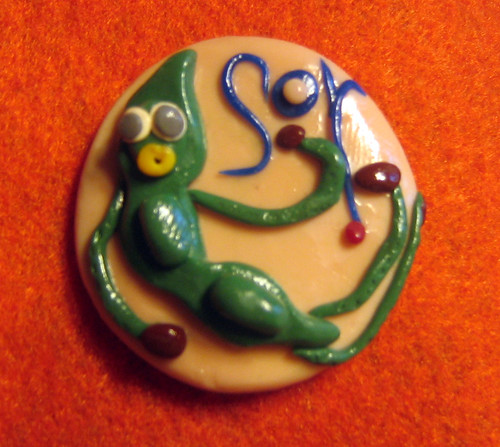
Then I made a tiny little kangaroo (which is cooling off at the moment) out of the tiny bits of clay that I have left. I'm running out. And I won't be able to buy more until I get paid some more $ because I'm way po' at the moment. Anyway, the tiny kangaroo comes with an even TINIER purple baby kangaroo and I can't wait to glaze it and take glamour shots of it because it's just too cute. Ha.

Showing posts with label longy. Show all posts
Showing posts with label longy. Show all posts
Monday, March 12, 2007

Friday, March 2, 2007
Hearing and Not Listening
This is something that occurs too often. For non-musicians, this may seem like a surprising concept. However, people who can hear but do not listen are often found sitting in orchestras and chamber music groups. So much of what is taught in music is about how to make your instrument function properly. This is very important, yet the education cannot stop there. The "why" factor is not answered or questioned often enough. "Play with curved fingers." OK, why? Because it looks nice? Well, no. Curved fingers will get you the most clarity (on a stringed instrument) in fast passage work. It SOUNDS the best, it is the most musical way to tackle a specific gesture, and it works. How about a slow melodic passage? Should your fingers intersect the string at a right angle? Well, perhaps, but it sounds bad. Why? Well, most people don't even notice this fact. It is because playing at a right angle to the string involves playing with the smallest amount of pad on the fingerboard, causing a long note to sound thin and have no over-tones. Playing with MORE pad of the finger allows a longer portion of the string to be in contact with the fingerboard, allowing the instrument to resonate and produce beautiful over-tones. So how do you get more pad of your finger on the string? Well, it depends on your hand. If you have big honking fingertips, you're in luck. But if your fingers are thin, you'll have to flatten the top joint a bit. Sure it "looks bad," but if it sounds good, who the hell cares? The SOUND is the what matters.
Listening to oneself is where the music begins. It is crucial for a musician to be aware of how they sound on their individual instrument in order to play with others. When a string quartet is trying to fix intonation of a particularly gnarly passage, it is not wise to play it slowly and loudly. It is important to play softly yet with a core sound in order to hear everyone and make necessary adjustments.
I had an interesting experience in orchestra yesterday. We were doing string sectionals, and Terry King (my teacher) and Laura Bossert (his wife, who is a violin teacher at Longy and I consider her to be my second teacher) were leading the ensemble. It was revealed to me that very few people were listening. Sure the violinists were great as individuals, but when they were asked to play together, it was a total mess. This was also very depressing. Terry and Laura were very disappointed because this was an indication that the orchestra did not know how to listen. I spoke with Terry during break, and he said, "I can't fix everything. All I can do is shine a mirror to them and hope that they can do the necessary work to make changes." It kills me to play in a mediocre orchestra, because I know that it feels great to play in a great orchestra. Granted, this has only happened a few times, and my heart is not set on being an orchestral cellist in the future, but it would certainly be nice to WANT to WANT to be in an orchestra where everyone is on the same page.
Hrmph.
Listening to oneself is where the music begins. It is crucial for a musician to be aware of how they sound on their individual instrument in order to play with others. When a string quartet is trying to fix intonation of a particularly gnarly passage, it is not wise to play it slowly and loudly. It is important to play softly yet with a core sound in order to hear everyone and make necessary adjustments.
I had an interesting experience in orchestra yesterday. We were doing string sectionals, and Terry King (my teacher) and Laura Bossert (his wife, who is a violin teacher at Longy and I consider her to be my second teacher) were leading the ensemble. It was revealed to me that very few people were listening. Sure the violinists were great as individuals, but when they were asked to play together, it was a total mess. This was also very depressing. Terry and Laura were very disappointed because this was an indication that the orchestra did not know how to listen. I spoke with Terry during break, and he said, "I can't fix everything. All I can do is shine a mirror to them and hope that they can do the necessary work to make changes." It kills me to play in a mediocre orchestra, because I know that it feels great to play in a great orchestra. Granted, this has only happened a few times, and my heart is not set on being an orchestral cellist in the future, but it would certainly be nice to WANT to WANT to be in an orchestra where everyone is on the same page.
Hrmph.
Wednesday, February 21, 2007
Long Day. Lots of cello stuff.
Woof. Yesterday was a rather long day. I had my orchestra repertoire class, my Baroque performance topics class, my lesson, orchestra, and then I performed in the composer's concert. My lesson was, of course, the high point of my day, yet I also got a lot out of my Baroque class. In my lesson we worked on Beethoven's 5th cello sonata in D major. This piece is quite fabulous. Especially the last movement, because it's a fugue, and fugues are one of my favorite things in the world. They are also ridiculously hard to make work well. The thing about Beethoven's music that I am learning more and more is that there is SO much musical information in every note/gesture/phrase/rest. And it is the duty of the performer to convey that meaning in a convincing manner. For example, let us take the first "statement" made by the cello at the beginning of the sonata in the first movement. It's a D major arpeggio. Big woop-tee-doo. But this is the first statement of the piece and it must be very strong and have direction. This figure interrupts the piano's sequential pattern and takes it to a new place. Within three seconds the whole musical gesture is entirely transformed from a rather stately motive and ascends in pitch while getting softer and sweeter (dolce). There are stacatto markings on the D and F# that follow a slurred pair of notes, and the motive finally lands on a high A. To go from a very "core"-sounding D on the C-string to a A on the A-string is incredibly difficult to do well. So of course this means OCD practice! I'm training myself to really enjoy every sound I make, not just play what's there. Also, for you cellists out there, I highly recommend starting the piece on a down-bow even though the first note occurs on an upbeat. This gives strength to the D. To compensate for the backwards feel of the bow, take two up-bows on the D and F# on the A-string (the notes with dots). However since these dots are under slurs, do not play "peck-ish" stacatto notes. These notes are almost a hybrid of stacatto and/portato and the bow does not actually stop on the string. Think of a brush stroking the string and then releasing just a bit of tension in the hair upon switching from D to F#. :)
Woo! That's just the first measure! Anyway, I have to go through a similar process with the whole piece. I also learned something quite interesting. Beethoven was a TERRIBLE proof-reader, and there was a lot of stuff left out. Slurs, dots, some dynamics, some other stuff. So if you're playing Beethoven's music and all of the sudden an unexpected musical thing happens that feels awkward, chances are that your instincts are correct and something is indeed awkward. If he writes a long note tied to a bunch of 16th notes and then randomly the tie is gone 2 measures later, take a look at the piano part, really examine what's happening in the music, and make your decision (sorry that sentence was way too long).
So today will be the first time I get together with the pianist and I'm really looking forward to it.
Woo! That's just the first measure! Anyway, I have to go through a similar process with the whole piece. I also learned something quite interesting. Beethoven was a TERRIBLE proof-reader, and there was a lot of stuff left out. Slurs, dots, some dynamics, some other stuff. So if you're playing Beethoven's music and all of the sudden an unexpected musical thing happens that feels awkward, chances are that your instincts are correct and something is indeed awkward. If he writes a long note tied to a bunch of 16th notes and then randomly the tie is gone 2 measures later, take a look at the piano part, really examine what's happening in the music, and make your decision (sorry that sentence was way too long).
So today will be the first time I get together with the pianist and I'm really looking forward to it.
Subscribe to:
Posts (Atom)